
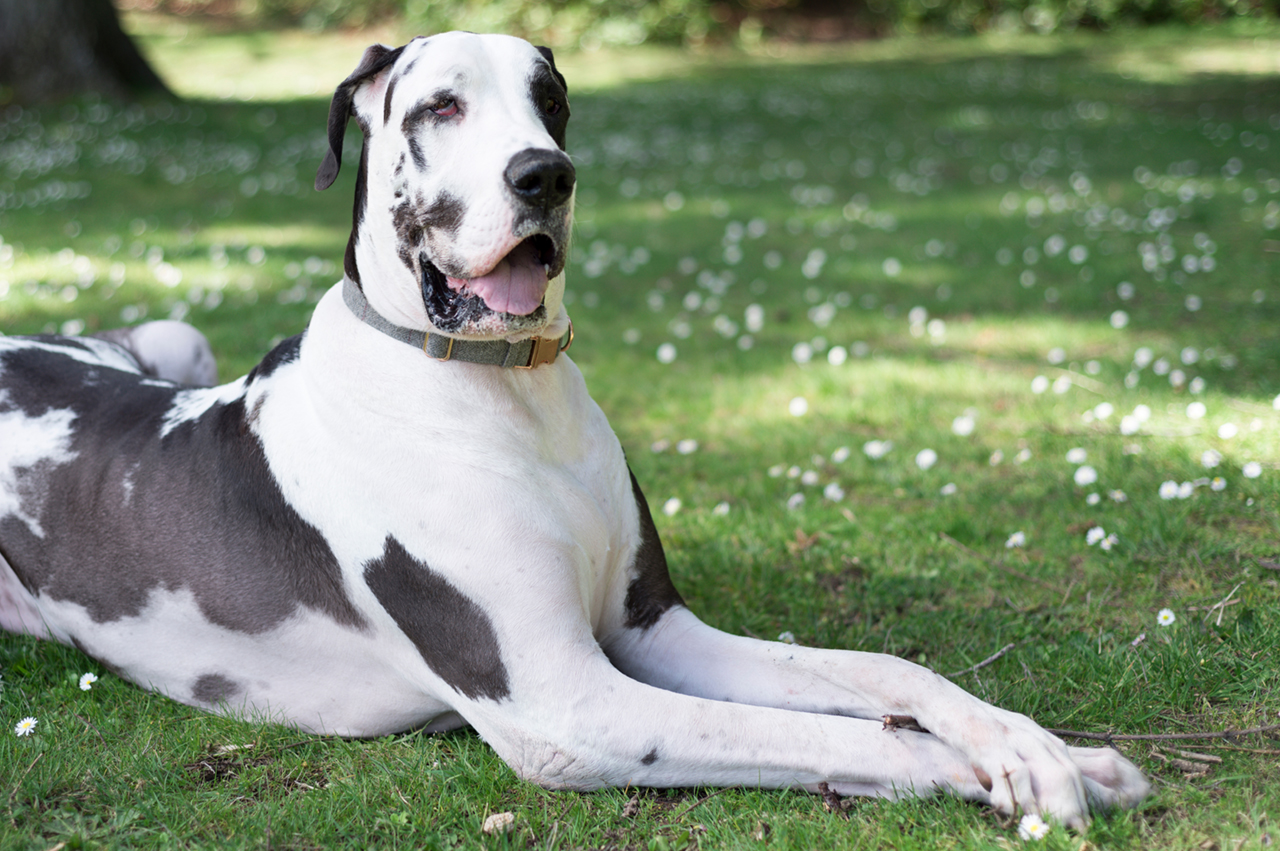
They call the Great Dane the "Apollo of dogs" for a reason. These gentle giants move through a room like royalty — impossibly tall, impossibly calm, with a soulful gaze that makes you forget you're looking at a dog that could comfortably rest its chin on your kitchen bench. Great Dane owners will tell you that nobody warned them they'd become completely obsessed with a creature the size of a small horse that insists on being a lapdog. They're soft, devoted, and genuinely funny in their obliviousness to their own size.
But Great Danes carry a brutal statistical reality beneath all that magnificence. Their deep, barrel chest makes them one of the highest-risk breeds in the world for bloat and GDV (gastric dilatation-volvulus) — a life-threatening emergency where the stomach fills with gas and rotates, cutting off blood supply. GDV is the #1 killer of Great Danes. Emergency surgery costs $5,000–$10,000 and must happen within hours or the dog dies. Studies suggest up to 40% of Great Danes will experience GDV at some point in their lives — not a remote possibility, but a near-statistical certainty for the breed.
Add dilated cardiomyopathy, Wobbler's Syndrome, osteosarcoma, and hip dysplasia to that picture — and factor in a heartbreakingly short lifespan of just 7–10 years — and you have a breed where serious, expensive veterinary events aren't a question of if, but when. Many Great Dane owners will face multiple five-figure vet bills within a single dog's lifetime.
We compared real pricing from major Australian pet insurers for a comparable large-breed dog in Sydney to find the best coverage options for Great Dane owners in 2026.
Last updated: April 2026
Quick Comparison: Top Providers for Great Danes
| Provider | Monthly Premium | Annual Limit | Excess | Benefit % | Our Take |
|---|---|---|---|---|---|
| Budget Direct ⭐ | ~$75–$120 | $12,000–$25,000 | $100–$200 | 80% | Best value — solid limits at the lowest price point for a giant breed with near-certain major claims |
| Bow Wow Meow | ~$95–$280 | $10,000–$30,000 | $0–$500 | 70–90% | Best flexibility — highest limits + GapOnly instant claiming for GDV emergencies at 2am |
| Pet Circle | ~$92–$225 | $10,000–$30,000 | $75–$150 | 70–90% | Best mid-range — useful $17,500 tier with solid plan variety |
⚠️ Premiums shown are indicative, based on quotes for a comparable large-breed dog (3-year-old desexed male) in Sydney (2000 postcode), sourced April 2026. Great Dane-specific quotes may be slightly higher given giant breed status — always get a personalised quote for your dog.
Why Great Danes Need Insurance More Than Almost Any Other Breed
Let's put this plainly: Great Danes are one of the most expensive breeds to own in Australia on a per-year basis, despite their relatively short lifespan. The vet bills don't spread out across 14 years like a Labrador's — they tend to arrive concentrated in a 7–9 year window, with GDV risk ever-present from the moment your Dane is old enough to wolf down a meal.
When you combine a 40% lifetime GDV risk with high rates of cardiac disease, a significant osteosarcoma risk shared with all giant breeds, and Wobbler's Syndrome, the financial case for insurance is overwhelming. The question isn't whether you'll need it. It's whether it'll be active when the emergency arrives at 2am.
Common Great Dane Health Issues & Typical Vet Costs
| Condition | What It Is | Typical Cost |
|---|---|---|
| Bloat/GDV (Gastric Dilatation-Volvulus) | The stomach fills with gas and rotates, cutting off blood supply to organs. Life-threatening emergency — Great Danes are one of the highest-risk breeds. Without immediate surgery, death follows within hours. GDV is the #1 killer of the breed. | $5,000–$10,000 (emergency surgery + ICU hospitalisation) |
| Dilated Cardiomyopathy (DCM) | Progressive weakening and enlargement of the heart muscle. Great Danes have elevated DCM risk alongside Dobermans — the condition causes the heart to lose pumping efficiency, leading to congestive heart failure. Requires lifelong management. | $3,000–$6,000 initial diagnosis + specialist workup; $1,500–$4,000/year ongoing medication + monitoring |
| Wobbler's Syndrome (CSM) | Cervical spondylomyelopathy — compression of the spinal cord in the neck, causing a characteristic wobbly rear gait, weakness, and potential paralysis. Surgical decompression is the gold standard for severe cases. | $7,000–$15,000 (surgical intervention); $2,000–$5,000 (medical management) |
| Osteosarcoma (Bone Cancer) | Aggressive bone cancer disproportionately affecting giant breeds. Great Danes are at significantly elevated risk. Standard treatment involves amputation plus a chemotherapy protocol. | $8,000–$20,000 (amputation + chemo) |
| Hip Dysplasia | Malformation of the hip joint causing pain, progressive lameness, and arthritis — extremely common in giant breeds. Managed medically or surgically depending on severity. | $3,000–$7,000 per hip (surgery); $1,000–$3,000/year (ongoing management) |
| Hypothyroidism | Underactive thyroid causing weight gain, lethargy, coat changes, and skin issues. Requires lifelong daily medication and periodic blood testing. | $300–$800/year (medication + regular blood tests) |
| Cruciate Ligament (ACL) Rupture | Tear of the knee ligament — carrying a giant breed's weight makes this a serious mechanical challenge. TPLO surgery is typically required. Can be bilateral. | $4,500–$7,500 per knee |
| Elbow Dysplasia | Developmental joint condition of the elbow — common in large and giant breeds. Causes progressive lameness and pain. | $2,500–$5,000 per elbow (surgery) |
| Cardiomegaly / Other Cardiac Conditions | Enlarged heart and associated arrhythmias. Distinct from DCM but related cardiac monitoring is recommended for all Great Danes. | $800–$2,000/year (cardiac monitoring + management) |
The GDV Problem — Great Danes' Defining Health Challenge
Gastric dilatation-volvulus is the defining health crisis of the Great Dane breed. No other condition kills more Great Danes, and the mechanics of why are straightforward: the breed's deep, narrow chest and large stomach capacity create ideal conditions for the stomach to fill with gas and rotate (volvulus). Once the stomach twists, blood supply to the stomach and spleen is cut off, and the dog's condition deteriorates rapidly.
Here's what the numbers look like:
- Lifetime prevalence: Studies estimate up to 40% of Great Danes will experience a GDV episode during their lifetime
- Age of onset: Can occur at any age — Great Danes as young as 1–2 years have experienced GDV
- Mortality without treatment: Near 100% — GDV is always fatal without emergency surgery
- Survival with prompt surgery: 80–90% for uncomplicated cases; lower for dogs with delayed presentation or tissue necrosis
- Time window: Hours — a Great Dane showing symptoms of GDV (distended belly, unproductive retching, restlessness, pale gums) is an emergency and must reach a vet within 1–2 hours
- Emergency cost: $5,000–$10,000 including surgery, anaesthesia, ICU hospitalisation, and intensive monitoring
The preventive procedure — prophylactic gastropexy (surgically tacking the stomach to prevent rotation) — is increasingly recommended for Great Danes and other deep-chested giant breeds. Cost: $1,500–$3,000 when done electively, or $2,000–$4,000 when combined with desexing. Even with gastropexy, Great Danes can still experience bloat (stomach dilation without rotation) — but the rotation is prevented, converting a life-threatening emergency into a serious but manageable condition.
The implication for insurance: GDV emergencies arrive without warning, at any hour, often at after-hours emergency vets where upfront payment of $5,000–$10,000 is expected before surgery begins. Not having that cash — or having it tied up — can mean losing the dog. GapOnly claiming, available through Bow Wow Meow at participating vets, means you don't need the cash upfront. The insurer settles directly with the vet.
The Lifespan Equation
Great Danes have one of the shortest lifespans of any breed — 7–10 years on average, with the sweet spot of 8–9 years. Compare this to Labradors (12–14 years), Border Collies (12–15 years), or Groodles (10–15 years).
This creates a unique insurance dynamic: you have less time to "build up" in premiums, but the bills tend to arrive faster and hit harder. A 3-year-old Great Dane is already entering the window where GDV risk peaks. By age 5–6, cardiac conditions become more likely. By age 7–8, osteosarcoma risk is elevated. Many Great Dane owners face $30,000–$60,000+ in vet bills over a 8–9 year lifespan — concentrated, intense, and unforgiving.
The short lifespan doesn't make insurance less valuable for Great Danes. If anything, it makes it more urgent — there are fewer healthy years to absorb premium costs before the major health events begin.
Detailed Provider Reviews
Budget Direct ⭐ Editor's Pick
Best for: Best value comprehensive cover for a giant breed with near-certain major health events — the premiums make mathematical sense
Budget Direct is the standout value option for Great Dane insurance. Their $25,000 Plus plan at ~$101–$112/month is the most affordable path to meaningful annual coverage for a breed where a single GDV emergency can cost $10,000 and DCM management can run for years. Over a 9-year lifespan, Budget Direct's premiums cost roughly $11,000–$13,000 — less than a single GDV + DCM year combined.
Indicative premiums (3yo male, large breed, Sydney):
| Plan | Annual Limit | Excess | Monthly Premium |
|---|---|---|---|
| Essential | $12,000 | $200 | ~$75/mo |
| Essential | $12,000 | $100 | ~$83/mo |
| Comprehensive | $15,000 | $200 | ~$83/mo |
| Comprehensive | $15,000 | $100 | ~$92/mo |
| Plus | $25,000 | $200 | ~$107/mo |
| Plus | $25,000 | $100 | ~$120/mo |
Note: Prices based on comparable large-breed dog quotes. Giant breed (Great Dane) quotes may be slightly higher — get a personalised quote for accuracy.
Key features:
- Annual limit: $12,000–$25,000
- Benefit percentage: 80% across all plans
- Excess: $100 or $200 per claim
- Underwritten by Auto & General — one of Australia's largest general insurers
- Routine Care add-on available (covers check-ups, vaccinations, heartworm)
- Emergency GDV surgery: Covered under accident/illness provisions
Waiting periods:
- Accident: 2 days
- Illness: 30 days
- Cruciate ligament: 6 months
- Pre-existing conditions: Not covered
Pros:
- Cheapest premiums for comparable coverage — critical for a breed with near-certain major claims
- $25,000 Plus limit handles a GDV emergency ($10,000) plus DCM management in the same year
- Simple plan structure — no complex combinations to navigate
- 80% benefit is consistent and predictable
- Routine Care add-on helps offset preventive care costs
Cons:
- No 90% benefit option — you always contribute 20% co-pay
- $12,000 Essential limit inadequate for serious Great Dane conditions (GDV surgery alone is $5,000–$10,000; add a second condition and you're out)
- $25,000 Plus limit may be exhausted in a catastrophic year (GDV + Wobbler's surgery + DCM)
- No GapOnly claiming — you pay upfront and claim back, which is difficult for $10,000 GDV emergencies at 2am
- $3,500 cruciate sub-limit on Plus plan is low for a giant breed bilateral TPLO ($9,000–$15,000)
Get a Quote from Budget Direct →
Bow Wow Meow
Best for: GapOnly instant claiming for GDV emergencies, maximum annual limits, and highest flexibility — the premium choice for Great Dane owners who want full protection
For Great Danes, Bow Wow Meow's killer feature is GapOnly. GDV happens at 2am, the emergency vet wants $8,000 before the dog goes into theatre, and you either have it or you don't. With GapOnly at participating vets, the insurer pays the vet directly for the gap — you only cover the excess and co-pay. For a breed where the #1 killer can strike any night, GapOnly isn't a nice-to-have. It's potentially life-saving.
Their $30,000 annual limit is also the highest available — important for a breed where a single worst-case year (GDV + Wobbler's surgery + DCM diagnosis) could exceed $20,000.
Indicative premiums (3yo male, large breed, Sydney):
| Annual Limit | Benefit % | $0 Excess | $250 Excess | $500 Excess |
|---|---|---|---|---|
| $10,000 | 70% | $168/mo | $95/mo | — |
| $10,000 | 80% | $202/mo | $112/mo | — |
| $10,000 | 90% | $240/mo | $131/mo | $102/mo |
| $20,000 | 80% | $221/mo | $122/mo | $96/mo |
| $20,000 | 90% | $263/mo | $145/mo | $112/mo |
| $30,000 | 80% | $233/mo | $128/mo | $100/mo |
| $30,000 | 90% | $280/mo | $152/mo | $118/mo |
Note: Prices based on comparable large-breed dog quotes — Great Dane-specific quotes may be slightly higher. Always get a personalised quote.
Key features:
- Annual limit: $10,000–$30,000 (highest available)
- Benefit percentage: 70%, 80%, or 90%
- Excess options: $0, $250, or $500
- GapOnly — instant claims at participating vets (no upfront payment required)
- Underwritten by PetSure — Australia's largest pet insurer
- 0-day accident waiting period — immediate accident cover from day one
- Multi-pet discount available
Waiting periods:
- Accident: 0 days (immediate cover)
- Illness: 30 days
- Cruciate ligament: 6 months
- Pre-existing conditions: Not covered
Pros:
- GapOnly is a game-changer for GDV emergencies — no need to find $10,000 upfront at 2am
- $30,000 annual limit absorbs catastrophic Great Dane years (GDV + Wobbler's + cardiac in the same year)
- 90% benefit: only $1,500 out-of-pocket on a $15,000 Wobbler's surgery
- 0-day accident cover means immediate GDV protection from policy start
- $500 excess brings the $30K/80% plan to just ~$100/month — competitive value
- Maximum flexibility across excess, limit, and benefit combinations
Cons:
- At the top tier ($30K/90%/$0 excess), $280/month is a serious annual cost ($3,360/year)
- $10,000 limit tiers are genuinely dangerous for Great Danes — only $20K+ tiers make sense
- Complexity of combinations can be overwhelming — focus on $20K+ limits
- PetSure underwriting — compare directly with Pet Circle before choosing
Get a Quote from Bow Wow Meow →
Pet Circle
Best for: Mid-range option with a practical $17,500 limit tier, solid plan variety, and Pet Circle store savings
Pet Circle's $17,500 Comprehensive plan at ~$137/month offers a practical middle ground. The $75 excess Comprehensive Plus option at ~$158/month keeps per-claim costs low — meaningful for a breed with potentially frequent vet visits. The $30,000 Ultimate plan is also available for owners who want maximum coverage without committing to Bow Wow Meow.
Indicative premiums (3yo male, large breed, Sydney):
| Plan | Annual Limit | Excess | Benefit % | Monthly Premium |
|---|---|---|---|---|
| Essentials | $10,000 | $150 | 70% | ~$92/mo |
| Essentials Plus | $10,000 | $150 | 80% | ~$122/mo |
| Comprehensive | $17,500 | $150 | 80% | ~$137/mo |
| Comprehensive Plus | $17,500 | $75 | 90% | ~$158/mo |
| Ultimate | $30,000 | — | 90% | ~$205–$225/mo |
Note: Prices based on comparable large-breed dog quotes — always get a personalised Great Dane quote.
Key features:
- Annual limit: $10,000–$30,000
- Benefit percentage: 70%, 80%, or 90%
- Excess: $75 or $150 depending on plan
- Underwritten by PetSure — same underwriter as Bow Wow Meow
- Pet Circle store discounts — ongoing savings on food and supplies
- 0-day accident waiting period
Waiting periods:
- Accident: 0 days
- Illness: 30 days
- Cruciate ligament: 6 months
- Pre-existing conditions: Not covered
Pros:
- $17,500 tier is a useful mid-point — more protection than Budget Direct's $15,000 cap, cheaper than Bow Wow Meow's $20K tiers
- $75 excess on Comprehensive Plus keeps per-claim costs low
- 90% benefit on Comprehensive Plus and Ultimate reduces out-of-pocket on big bills
- Pet Circle store savings partially offset premium cost
- 0-day accident cover
Cons:
- $10,000 Essentials tiers are insufficient for serious Great Dane conditions
- $17,500 Comprehensive limit will be tested by a GDV ($10,000) plus any second condition
- No GapOnly claiming — upfront payment still required
- Same PetSure underwriting as Bow Wow Meow — compare before choosing
How We Compared
We sourced indicative pricing from major Australian pet insurers in April 2026 for a 3-year-old desexed male large-breed dog in Sydney (postcode 2000). Great Dane-specific live quotes may vary slightly given giant breed status; prices shown are based on comparable large-breed dog data — always get a personalised quote for your specific dog.
What we looked at:
- Premiums: Monthly cost across different cover levels, excess options, and benefit percentages
- Annual limits: How much the insurer pays per year — critical for a breed where a single GDV emergency is $10,000 and DCM management runs for years
- Benefit percentage: The percentage of the vet bill the insurer covers after excess
- GDV/bloat coverage: Whether emergency bloat surgery is covered (it should be, under accident provisions — but always confirm)
- Waiting periods: How long before cover kicks in — especially the 2-day accident waiting period (relevant for GDV risk)
- Claims process: Online, phone, or GapOnly instant processing — particularly important for Great Dane GDV emergencies
- Breed-specific coverage: DCM, Wobbler's Syndrome, osteosarcoma, hip dysplasia
💡 Pricing varies by age, location, and cover level. Always get a personalised quote for your specific Great Dane.
Buyer's Guide: What to Look for in Great Dane Insurance
1. GDV/Bloat Coverage — Confirm Before You Sign
This is the first thing to verify. GDV is the #1 killer of Great Danes and constitutes a sudden, acute emergency — it should fall under accident coverage in most comprehensive policies. Before signing up, confirm:
- Emergency GDV surgery is covered — including anaesthesia, surgical procedure, post-op ICU, and hospitalisation
- The accident waiting period — Budget Direct's 2-day wait means your first 48 hours aren't covered. Bow Wow Meow and Pet Circle offer 0-day accident cover from day one
- No sub-limits on emergency surgery — some policies apply a per-condition cap on surgical procedures; confirm GDV surgery is covered to the full annual limit
- GapOnly access — if you don't have $8,000–$10,000 instantly available, Bow Wow Meow's GapOnly is worth the premium difference
2. High Annual Limit ($20,000 Minimum)
For Great Danes, we recommend a minimum $20,000 annual limit — ideally $25,000 or $30,000. Here's a realistic bad year:
- Emergency GDV surgery + ICU: $8,000–$10,000
- DCM diagnosis (specialist cardiology): $2,000–$3,000
- First year cardiac medication: $2,000–$3,000
- Total in one year: $12,000–$16,000 — before any other conditions
A $12,000 limit is gone before you've addressed the cardiac diagnosis. Budget Direct's $25,000 Plus plan handles most single-year scenarios. Bow Wow Meow's $30,000 plan is the gold standard for worst-case coverage.
3. Cardiac Coverage
Confirm your policy:
- Covers DCM diagnosis — specialist cardiology workup including echocardiogram ($1,500–$2,500)
- Covers ongoing cardiac medication — pimobendan, ACE inhibitors, other drugs ($1,500–$3,000/year)
- Has no per-condition caps on cardiac disease — check the PDS for sub-limits on heart conditions
- Covers specialist cardiology consultations — regular monitoring appointments
The 30-day illness waiting period applies to DCM. Insuring young means your Dane enters coverage before any cardiac findings are noted.
4. Prophylactic Gastropexy — Insurance Interaction
Many Great Dane owners opt for prophylactic gastropexy — surgical tacking of the stomach to prevent rotation. This is an elective procedure typically done at the same time as desexing.
Key insurance consideration: if gastropexy is done before you insure your dog and is listed in the medical records, insurers may view future bloat/gastric events differently. If done after insuring, the surgical cost may be claimable under elective procedure provisions (varies by policy — check your PDS). Always confirm with your insurer.
Gastropexy doesn't eliminate GDV insurance risk — Great Danes can still experience bloat (dilation without rotation) requiring treatment — but it does remove the most catastrophic outcome.
5. Osteosarcoma Coverage
Bone cancer is aggressive, expensive, and disproportionately affects giant breeds. Ensure your policy:
- Covers cancer treatment — diagnosis, surgery (amputation), and chemotherapy
- Has sufficient limits — osteosarcoma treatment ($8,000–$20,000) can exhaust smaller plans
- No cancer exclusions — some lower-tier plans apply sub-limits or exclusions on cancer treatment
6. Insure Young — Especially for GDV Risk
The window to insure a Great Dane cleanly is short:
- GDV can strike from age 1–2 — any documented gastric episode before insuring is a pre-existing condition
- DCM signs may appear from age 3–4
- Hip dysplasia is often evident on X-ray from 6–12 months
- Wobbler's signs can appear from age 3–5
Every vet visit before you insure is a potential exclusion. A puppy with zero vet history gets the cleanest policy. A 4-year-old Great Dane with a vet history may already have several exclusions. Insure at 8 weeks. Or as soon as you bring them home.
Note also: Bow Wow Meow and Pet Circle offer 0-day accident waiting — meaning your Great Dane has GDV accident coverage from day one of the policy. Budget Direct's 2-day accident waiting means the first 48 hours are unprotected. This matters more for Great Danes than almost any other breed.
Great Dane Insurance: The Financial Case
Let's look at the numbers over a typical 8–9 year Great Dane lifespan:
Best case (unusually healthy Great Dane):
- Annual check-ups, vaccinations, preventatives, joint supplements: ~$2,000–$3,500/year
- Cardiac monitoring from age 3: ~$600–$1,200/year
- Minor issues: ~$500–$1,500/year
- Total over 8 years: ~$25,000–$50,000
Average case (typical Great Dane trajectory):
- Everything above, plus:
- One GDV emergency: $5,000–$10,000
- Hip dysplasia management: $3,000–$8,000
- Hypothyroidism management (5+ years): $2,000–$5,000
- DCM diagnosis + ongoing cardiac management: $8,000–$15,000
- Total over 8 years: ~$43,000–$88,000
Worst case (GDV + Wobbler's + osteosarcoma):
- Everything above, plus:
- Wobbler's Syndrome surgery: $7,000–$15,000
- Osteosarcoma treatment (amputation + chemo): $8,000–$20,000
- Second GDV episode (gastropexy failed to prevent dilation): $3,000–$6,000
- Total over 8 years: ~$61,000–$129,000+
At Budget Direct's Plus plan (~$107/month, $200 excess), annual premiums are approximately $1,284. Over 8 years: ~$10,272. A single GDV emergency costs $5,000–$10,000 — the insurance effectively pays for itself with one event. If your Dane develops DCM on top of a GDV episode (which is statistically common given DCM prevalence in the breed), the policy pays for itself many times over.
Great Danes vs. Other Large Breeds: Insurance Context
| Breed | Monthly Premium Range | Primary Risk Drivers |
|---|---|---|
| Great Dane | ~$75–$280 | GDV (40% lifetime risk), DCM, Wobbler's, osteosarcoma, short lifespan |
| Doberman | $70–$265 | DCM (58% incidence), Wobbler's, vWD, GDV |
| Boxer | $70–$264 | Cancer (40%+), cardiomyopathy, bloat |
| Rottweiler | $60–$250 | Cancer, joint issues, heart disease |
| German Shepherd | $55–$230 | Hip/elbow dysplasia, spinal issues, DM |
| Labrador | $50–$200 | Joint issues, obesity complications |
| Golden Retriever | $50–$205 | Cancer (60%+ lifetime), hip dysplasia |
Great Danes sit at the premium end of large breed pricing — alongside Dobermans and Boxers. Their combined GDV risk + cardiac disease + cancer risk + short lifespan creates a uniquely dense concentration of potential vet costs over fewer years. The insurance math is hard to argue against.
Frequently Asked Questions
Does pet insurance cover bloat (GDV) surgery in Great Danes?
Yes — GDV is an acute, life-threatening emergency and falls under accident coverage in all major comprehensive pet insurance policies. Budget Direct, Bow Wow Meow, and Pet Circle all cover emergency bloat surgery, including surgical intervention, anaesthesia, ICU hospitalisation, and post-operative care. The main caveat: Budget Direct has a 2-day accident waiting period, meaning your first 48 hours are unprotected. Bow Wow Meow and Pet Circle offer 0-day accident cover — immediate GDV protection from the day your policy starts. If your Great Dane has previously experienced bloat or GDV, it may be excluded as a pre-existing condition.
Is pet insurance worth it for Great Danes?
Great Danes are one of the strongest financial arguments for pet insurance of any breed. With a ~40% lifetime GDV risk, elevated DCM rates, high osteosarcoma incidence, and a compressed 8–9 year lifespan that concentrates all vet bills into fewer years, most Great Dane owners will face at least one major health event costing $5,000–$10,000+ — and often several. At Budget Direct's entry pricing (~$75/month), premiums total roughly $7,200 over 8 years. A single GDV surgery costs $5,000–$10,000. The policy effectively pays for itself with one emergency. Read our full analysis of whether pet insurance is worth it in Australia.
How much does pet insurance cost for a Great Dane in Australia?
Based on indicative pricing for a comparable large-breed dog in Sydney (April 2026), Great Dane pet insurance ranges from approximately $75 to $280 per month, depending on provider, annual limit, excess, and benefit percentage. Entry-level coverage (Budget Direct Essential, $12,000 limit, 80% benefit, $200 excess) starts at ~$75/month. Solid mid-range coverage ($25,000 limit, 80% benefit) sits at $100–$130/month. Maximum cover (Bow Wow Meow $30K/90%/$0 excess) reaches ~$280/month. Giant breed quotes may be slightly higher than standard large-breed quotes — always get a personalised quote for your Dane.
Does pet insurance cover dilated cardiomyopathy (DCM) in Great Danes?
Yes — comprehensive pet insurance covers DCM diagnosis and treatment, including specialist cardiology consultations, echocardiograms, cardiac medications (including pimobendan), and ongoing monitoring, provided DCM was not diagnosed or showing symptoms before the policy started, and after the 30-day illness waiting period has expired. This is why insuring young Great Danes is critical. Once any cardiac abnormality is noted in vet records, it becomes a pre-existing condition excluded from coverage. Insure before any cardiac findings are documented.
Does pet insurance cover Wobbler's Syndrome in Great Danes?
Yes — Wobbler's Syndrome (cervical spondylomyelopathy) is covered as a neurological/orthopaedic condition by comprehensive policies, provided it was not present or symptomatic before the policy started. Coverage includes specialist neurology consultations, MRI/CT scanning, surgical decompression ($7,000–$15,000), and post-surgical rehabilitation. Check that your plan's orthopaedic or neurological sub-limits are sufficient — Budget Direct's Plus plan covers up to $25,000 for orthopaedic conditions, which handles most Wobbler's surgeries. Lower-tier plans with $4,000–$8,000 orthopaedic caps would leave major out-of-pocket costs.
When should I insure my Great Dane puppy?
As soon as possible — ideally from 8 weeks or the day you bring them home. Great Danes have a narrow window to insure cleanly because:
- GDV risk begins young — even 1-year-old Danes have experienced GDV
- Hip dysplasia may be evident on X-ray from 6–12 months
- DCM can be detected via echocardiogram from age 3
- Every vet visit before insuring is a potential exclusion
Puppy premiums are also 20–30% lower than adult premiums. Bow Wow Meow and Pet Circle's 0-day accident waiting means GDV coverage starts immediately — an important consideration given the breed's risk profile.
What annual limit do I need for a Great Dane?
We recommend a minimum $20,000 annual limit — ideally $25,000 or $30,000. A single GDV emergency ($5,000–$10,000) plus a DCM diagnosis ($2,000–$3,000) plus first-year cardiac medication ($2,000–$3,000) can total $9,000–$16,000 in one year. A $12,000 limit is gone before you've addressed the cardiac diagnosis. Budget Direct's $25,000 Plus plan handles most individual-year scenarios. For maximum peace of mind, Bow Wow Meow's $30,000 plan absorbs even catastrophic multi-condition years.
How does the Great Dane's short lifespan affect insurance value?
It concentrates the value. Great Danes typically live 7–10 years, meaning their vet bills are compressed into a shorter ownership window than most breeds. You pay fewer total years of premiums — but the health events (GDV, cardiac disease, bone cancer, joint surgery) tend to arrive earlier and harder than in longer-lived breeds. The insurance math is actually more favourable for Great Danes: fewer premium years to pay before a major claim arrives. At Budget Direct's Plus plan, you pay approximately $10,000 in premiums over 8 years — an amount that can be surpassed by a single GDV emergency combined with Wobbler's surgery. See our most expensive dogs to insure in Australia for a breed-by-breed comparison.
The Bottom Line
Great Danes are unlike any other dog. They are gentle, absurd, completely devoted, and will try to sit in your lap despite weighing more than you do. They are also, medically speaking, one of the most expensive breeds to own in Australia — with health risks that arrive earlier, hit harder, and cost more than most owners realise until they're in the middle of a 2am emergency vet visit.
GDV alone — the breed's #1 killer — is a near-statistical certainty for many Great Danes. Emergency surgery costs $5,000–$10,000. DCM, Wobbler's, osteosarcoma, and hip dysplasia fill in the rest of a sobering health picture. The only rational response is insurance that's active, comprehensive, and sufficient before any of these events occur.
Our recommendation: Start with Budget Direct's Plus plan at ~$107/month ($200 excess, $25,000 limit). It covers the most likely Great Dane scenarios at the lowest available premium. The 80% benefit and $25,000 limit handle a GDV emergency plus cardiac management within a single year. At approximately $1,284/year, it pays for itself the first time your Dane needs emergency surgery.
For owners who want maximum protection — particularly given GDV's tendency to arrive suddenly and at emergency rates — Bow Wow Meow's $30,000/80%/$500 excess plan at ~$100/month is the most cost-effective route to the highest available limit, with the critical addition of GapOnly claiming so you never need $10,000+ cash on hand at 2am.
Pet Circle's $17,500 Comprehensive Plus plan at ~$158/month (90% benefit, $75 excess) is the best mid-range choice if you want higher benefit percentage and lower per-claim costs without Bow Wow Meow's pricing.
Whatever you choose: insure your Great Dane young, choose the highest limit you can reasonably afford, and make sure your policy is active before the first emergency. With this breed, it's not a question of if — it's a question of when.
Compare pet insurance for other popular breeds: Dobermans · Boxers · Rottweilers · German Shepherds · Labradors · Golden Retrievers · Border Collies · French Bulldogs · Groodles
Also useful: Is pet insurance worth it in Australia? · How much does pet insurance cost? · Most expensive dog breeds to insure · Pet insurance pre-existing conditions explained
Affiliate disclosure: We may earn a commission when you click our links. This doesn't affect our ratings or recommendations.
Last reviewed: April 2026. Prices are indicative based on comparable large-breed dog quotes — always get a personalised quote for your Great Dane.